

The music of Charles O. Beck
Symphony No. 4 (primarily in A)
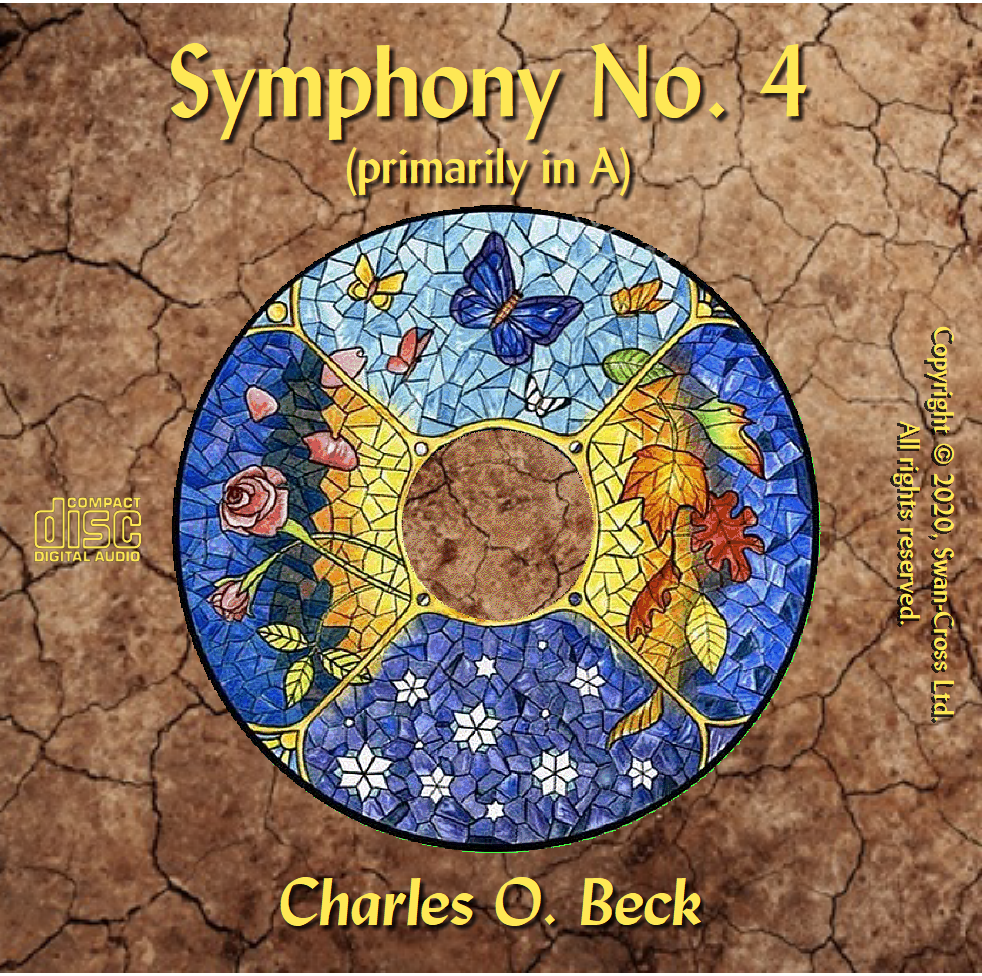 Finally.
This one actually comes closest to fulfilling my original aims when I started writing symphonies: That was, to simply write multi-movement pieces built on the basic concept of the symphony, as originally developed by Mozart and Haydn. I didn’t set out to write anything profound, either musicologically or conceptually. Rather, I just wanted to write pieces that were interesting musically, period-ically relevant, and maybe even a little fun. I guess I wanted to prove that the traditional classical music forms (such as the symphony) were not dead—or at least, they didn’t have to be. OK, so call me Don Quixote.
I.
II.
III.
IV.
Approx. total performance time: 24:22
As such, this piece has no real overarching conceptual underpinnings. I simply wanted to write something that evolved from the traditional symphony “form” and that might be kinda fun to listen to. So, the movements have no titles or conceptual drivers. The symphony itself has no subtitle.
The only real unifying element, if you want to call it that, was the idea of building all the thematic material and much of the underlying harmonic structure on the musical interval of a fourth. That’s it! (Well...that and lots of 4-note chords.) I was just interested in seeing how much I could do with that interval and, at the same time, create a symphony that reflected fidelity to the traditional symphonic “form” while still being fresh and contemporary. Nothing profound here. And yet—
This one happens to be my wife’s favorite one so far, and, in many ways, mine as well.
This work was begun in Staffpad, finished/scored in Finale, and later rendered in REAPER, using the EastWest Quantum Leap sound libraries. It was completed © in 2020.
“Praise Him with trumpet sound... harp and lyre... timbrel... stringed instruments and pipes... loud cymbals...”
“Praise the Lord!”
— Psalm 150
The Bible
-
Home
- † The Music
- † About Swan-Cross
- † Contact
Copyright © 2025, Swan-Cross, Ltd.
All rights reserved.